The word
Hofkapelle: chapel and court music
A Hofkapelle is both a court chapel and the musicians who served it. How the two meanings meet in Munich, from Lasso to the Bavarian State Orchestra.
Reserve a place in the chapel ↗Quick answer
A Hofkapelle is a court chapel, and also the group of musicians attached to a court. In Munich the court's musicians date back to 1523 and grew into today's Bavarian State Orchestra. The concert on this site is held in the chapel building, the Hofkapelle of the Residenz, and its players are billed as the Residenz Soloists.
One word, two meanings
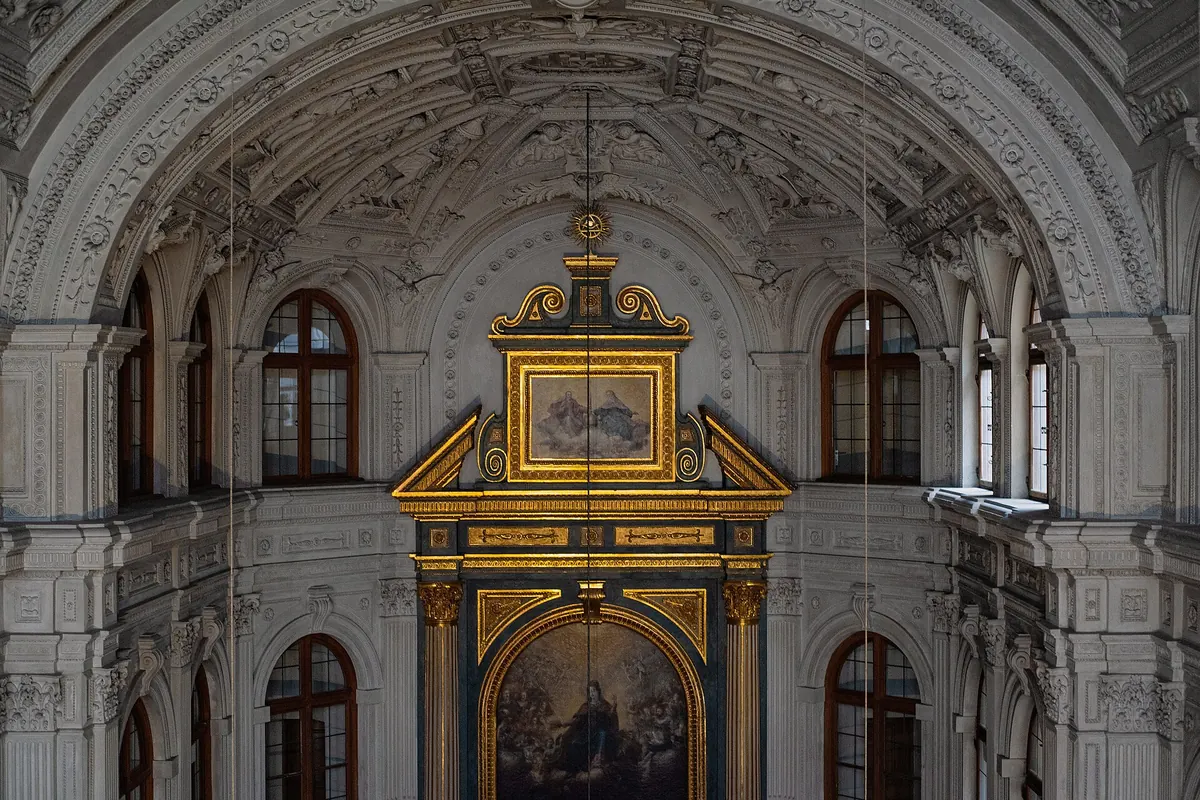
Hofkapelle means court chapel. In German the word is used both for a royal chapel and for any other court chapel. It can name a building, a musical ensemble or both together. As a musical institution, court chapels emerged in 16th-century Europe, when rulers brought itinerant musicians together into permanent groups. The aim was to keep religious ceremony continuous and to show off the splendour and taste of the court. In Munich the building and the musicians have separate histories, but they belong to the same court and the same palace.
The musicians of the Bavarian court
The origins of the Bavarian court's musical ensemble date back to 1523 and the time of the composer Ludwig Senfl, when sacred music was the focus of its work. Its musicians became famous across Europe after 1563, when the Belgian polyphonist Orlande de Lassus, known in English as Orlando di Lasso, was appointed maestro di cappella. He had joined the court of Duke Albrecht V in 1556. That court, which the palace later housed, was consciously building a musical establishment to rival the great courts of Italy.
From chapel to opera pit
In 1653 the first opera performances took place in Munich, which added to and greatly changed the musicians' work. In 1762 the ensemble was titled Hoforchester, the orchestra to the Bavarian court. In 1778, when Karl Theodor moved his court from Mannheim to Munich, 33 players of the Mannheim orchestra followed him. In 1781 Mozart conducted the musicians in the world premiere of Idomeneo. The ensemble was formally founded in 1811 as the Music Academy of the Bavarian State Orchestra and is today the orchestra of the Bavarian State Opera.
The chapel came later
The court chapel in the Residenz was built in 1601–1603, after Lasso's death in 1594, and replaced older devotional rooms in the Neuveste. So the great polyphony of Lasso's career was not written for this room. The building dates from the next generation of the dynasty, under Maximilian I, and it kept its original purpose for centuries: daily Mass for the court below and the ruling family in the galleries. The musicians who served the court worked across several rooms in the palace, and the sources consulted do not say which of them used this chapel. What the building gives you today is the setting, not the repertoire: a room made for a court's worship, in which a small group can be heard clearly.
Who plays at the concert
The concert on this site takes place in the chapel building, the Hofkapelle. Its players are billed by the organiser as the Residenz Soloists, a group assembled for the concert series, and nothing on the booking page ties them to the Bavarian State Orchestra. Think of it as chamber music in a court chapel, not as a performance by the court's historic orchestra. That distinction is worth making, because the two names look alike in a search and sound alike in conversation. The programme changes with the date, and the organiser names Bach, Vivaldi, Haydn and Mozart among the composers you may hear.
Read next: Munich Residenz concert: booking
Why the word matters when you search
Searching for Hofkapelle München brings up two kinds of result. One is the chapel in the Residenz, the room where this concert is held. The other is the history of the court's musicians, which leads to the Bavarian State Orchestra and the Bavarian State Opera. They are not the same thing, so a ticket for one will not get you into another. If you want a concert in the chapel, the booking button on this site leads to it. If you want the opera orchestra, look for its own series at the National Theatre.
Frequently asked questions
What does Hofkapelle mean?
Court chapel. The word names a chapel building, a court's ensemble of musicians, or both.
Is the Residenz Soloists group the Bavarian State Orchestra?
Nothing on the booking page says so. The Residenz Soloists are the organiser's concert group.
When did the Bavarian court's music begin?
The origins of the ensemble date back to 1523, in the time of Ludwig Senfl.
Did Lasso work in the Residenz chapel?
No. Lasso died in 1594 and the chapel was built in 1601–1603.
Sources